Case study · Insurance and home services — plumbing repairs
HomeAssist
Plumbing claims, from report to sign-off
A national plumbing-claims operation run from one system: report, dispatch, evidence and sign-off, with the customer informed at every step.
Live — in use for more than ten years
Project overview
Project snapshot
Responsibilities and status, stated plainly. Where the record is silent — a date, a measured result — the page says so rather than guessing.
- Industry
- Insurance and home services — plumbing repairs
- Target users
- Homeowners and insurers logging claims; a national panel of plumbers in the field; HomeAssist’s operations team
- GEMIS’s role
- Designer, builder and long-term support partner
- Scope
- Claim intake, automatic dispatch, customer communication, field evidence capture, insurer and manufacturer integration, national dashboard
- Status
- Live — in use for more than ten years
- Key deliverables
- Online claim reporting for homeowners and claim logging for insurers; Automatic assignment of the next available plumber near the job, from a national panel; SMS and WhatsApp updates to the customer at each step; A plumber app that photographs each step of the work as evidence of SANS compliance; Direct links to insurers and manufacturers that check warranties and update claims automatically; One national dashboard from first report to sign-off
The business challenge
Plumbing claims, from report to sign-off
One system for burst-geyser and plumbing jobs: nearest-plumber dispatch, SMS and WhatsApp updates, SANS photo evidence, insurer and warranty links.
A burst geyser is urgent for the homeowner, a claim for the insurer, and a dispatch problem for HomeAssist, which works with a national panel of plumbers.
Each party needed something different: the homeowner wanted to report the problem in minutes and then know what was happening; the insurer needed the claim logged and the warranty position checked; the plumber needed to prove that each step of the repair met SANS standards; and HomeAssist needed to see every job in the country without phoning around.
Handled by phone and email, those needs pulled in different directions: updates meant calls, evidence meant paperwork, and warranty checks meant waiting on manufacturers.
Discovery and evidence
What the design was based on
Only the evidence that exists is described here. Nothing is labelled research that was not.
The record holds no research report for this project. The design follows the four parties a burst geyser involves: the homeowner who reports it, the insurer who logs the claim, the plumber who repairs it, and HomeAssist, which coordinates a national panel.
What each needed is stated in the case study: the homeowner wanted to report in minutes and then know what was happening; the insurer needed the claim logged and the warranty checked; the plumber needed to prove each step met SANS standards; HomeAssist needed to see every job without phoning around.
Strategy and system structure
Why this approach fits the problem
- One job record, every party on it
- Dispatch by proximity and availability, not by phone
- Evidence captured where the work happens
GEMIS built the system around a single job record that every party sees from their own side. Whether the homeowner reports online or the insurer logs the claim, the job lands in the same place.
Dispatch was made automatic: the system finds the next available plumber near the job and assigns it, and the customer is kept informed by SMS or WhatsApp without anyone making a call.
On site, the plumber’s app captures a photograph at each step, so SANS compliance is evidenced as the work is done rather than reconstructed afterwards. Behind the scenes, direct links to insurers and manufacturers check warranties and update claims, and HomeAssist watches the whole country from one dashboard.
GEMIS built HomeAssist a single system for burst-geyser and plumbing jobs. Homeowners report online or insurers log claims; the system assigns the nearest available plumber from a national panel; customers get SMS or WhatsApp updates; plumbers photograph each step to prove SANS compliance; warranties and insurer claims update automatically; and HomeAssist sees every job nationwide in one dashboard.
Read the transcript
A geyser bursts. The homeowner goes online and reports it in minutes. Or her insurer logs the claim for her. Either way, the job lands in one place: the system GEMIS built for HomeAssist. HomeAssist works with a national panel of plumbers. The system finds the next available plumber near the job, and assigns it automatically. The customer is kept informed every step of the way, by SMS or WhatsApp. No phoning around for updates. On site, the plumber uses the app to photograph the work, proving each step meets SANS standards. Behind the scenes, the system links directly to insurers and manufacturers, checking warranties and updating claims automatically. HomeAssist sees every job across the country in one place, from first report to sign-off. Fewer phone calls. Faster repairs. GEMIS and HomeAssist have worked side by side for more than ten years.
The workflow as implemented
- Reported The homeowner reports online, or the insurer logs the claim
- One job record Either way, the job lands in the same place
- Dispatched The next available plumber near the job is assigned automatically
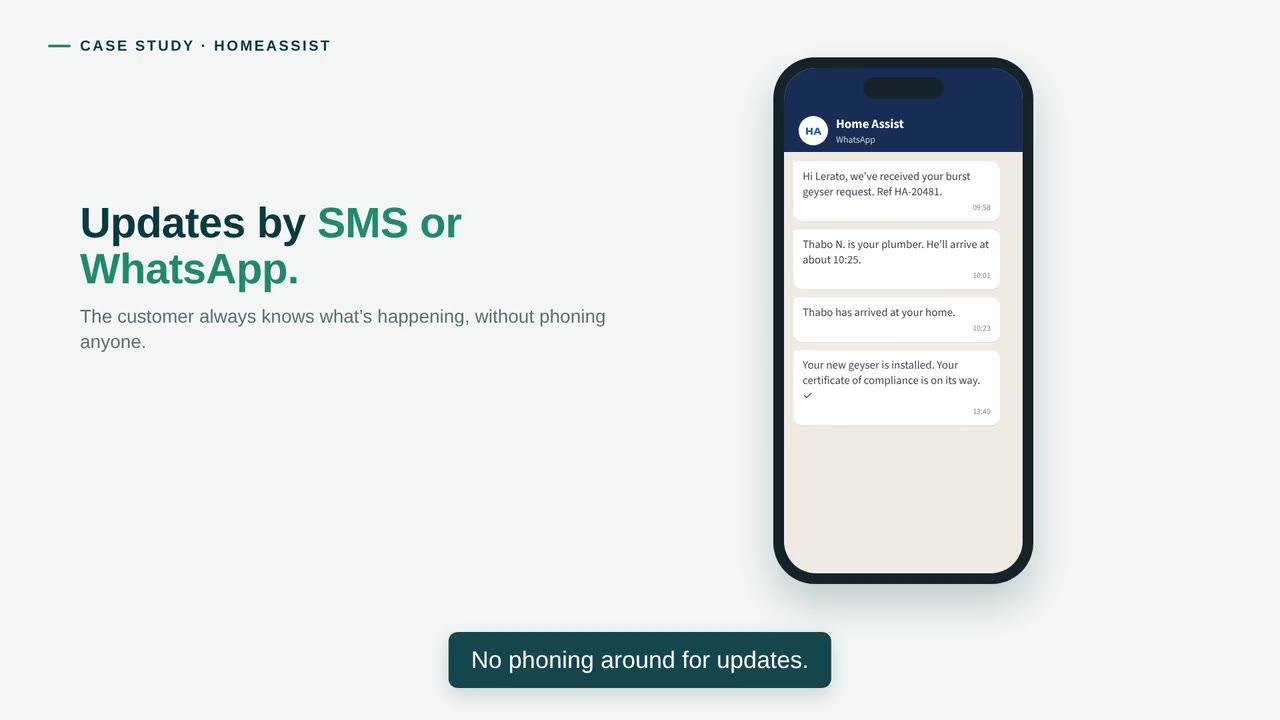
- Informed SMS or WhatsApp updates to the customer at every step
- Evidenced The plumber photographs each step in the app — SANS compliance
- Signed off Insurer and manufacturer links update the claim; one national view
The system, step by step
What the user needs to do, and how the system supports it
Stills from the case study video. The interfaces are illustrated for the video, not screen recordings of the production system; every capability shown is one the system delivers.
-
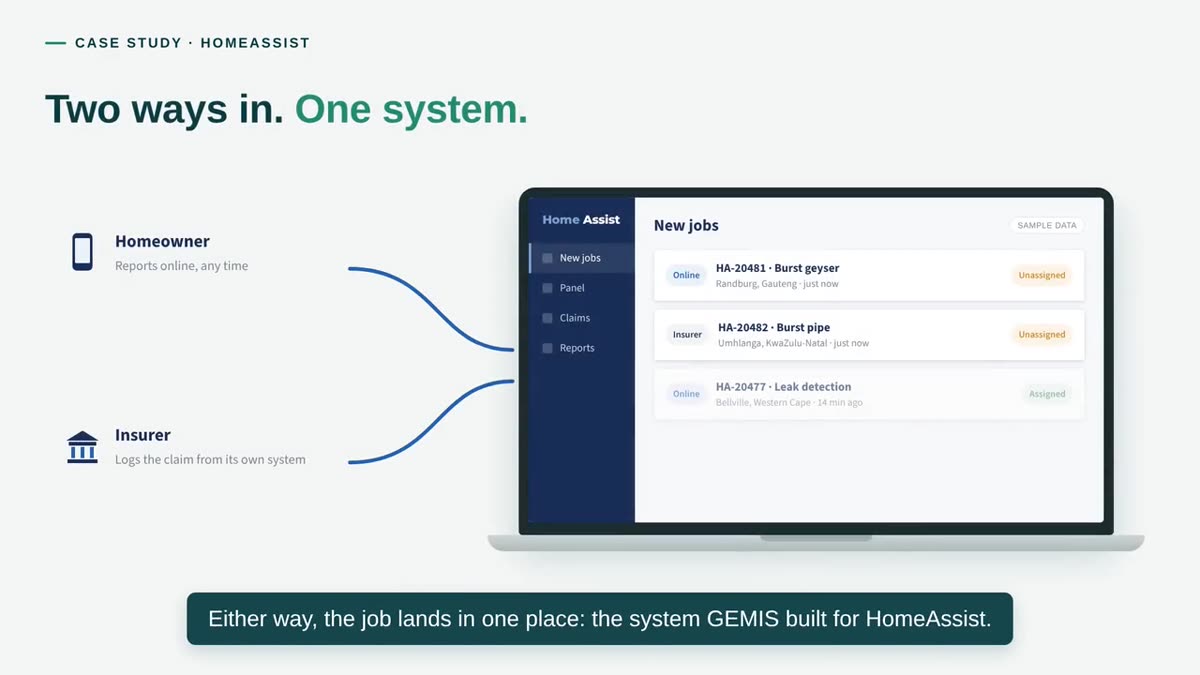
Illustrated in the case study video Two ways in. One system.
The homeowner reports the burst geyser online in minutes, or the insurer logs the claim for them. Either way the job lands in one place.
-
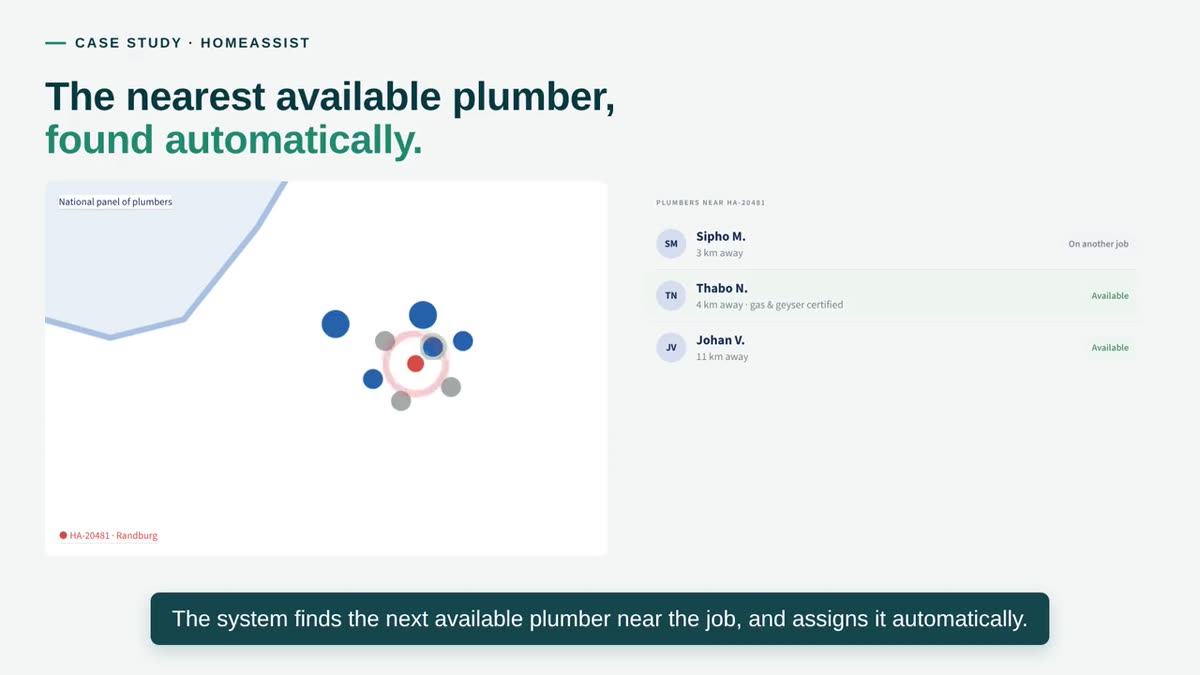
Illustrated in the case study video The nearest available plumber, found automatically
HomeAssist works with a national panel. The system finds the next available plumber near the job and assigns it, without a phone call.
-
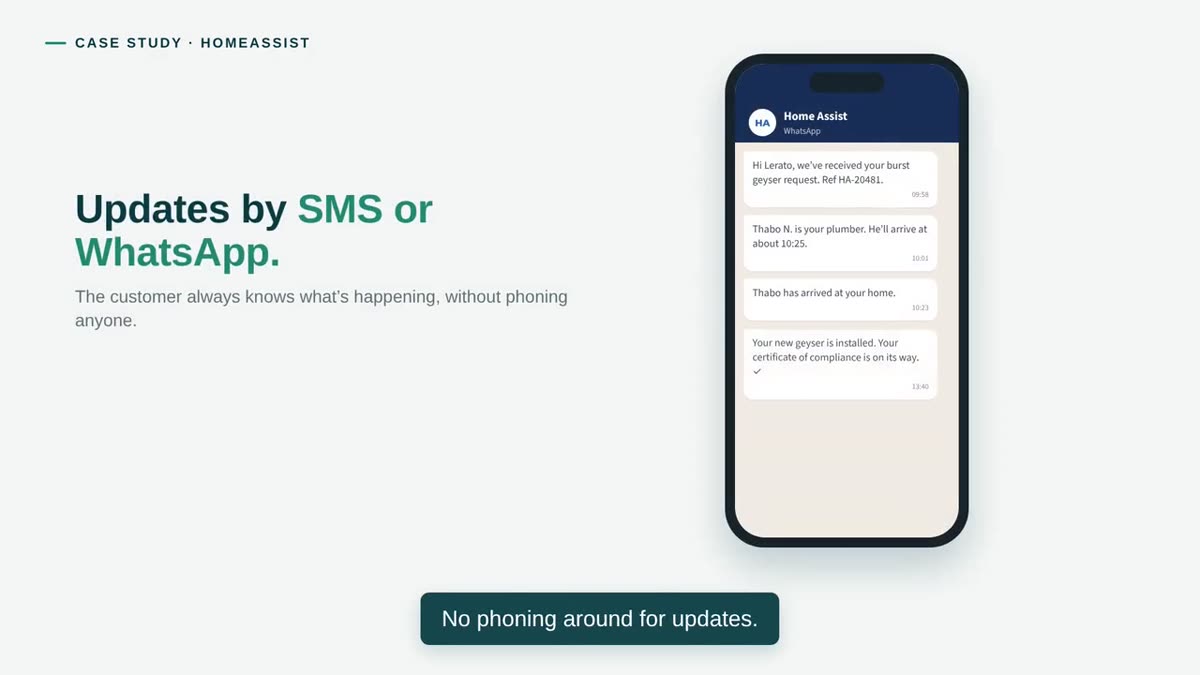
Illustrated in the case study video Updates by SMS or WhatsApp
The customer is kept informed at every step, so nobody has to phone around for updates.
-
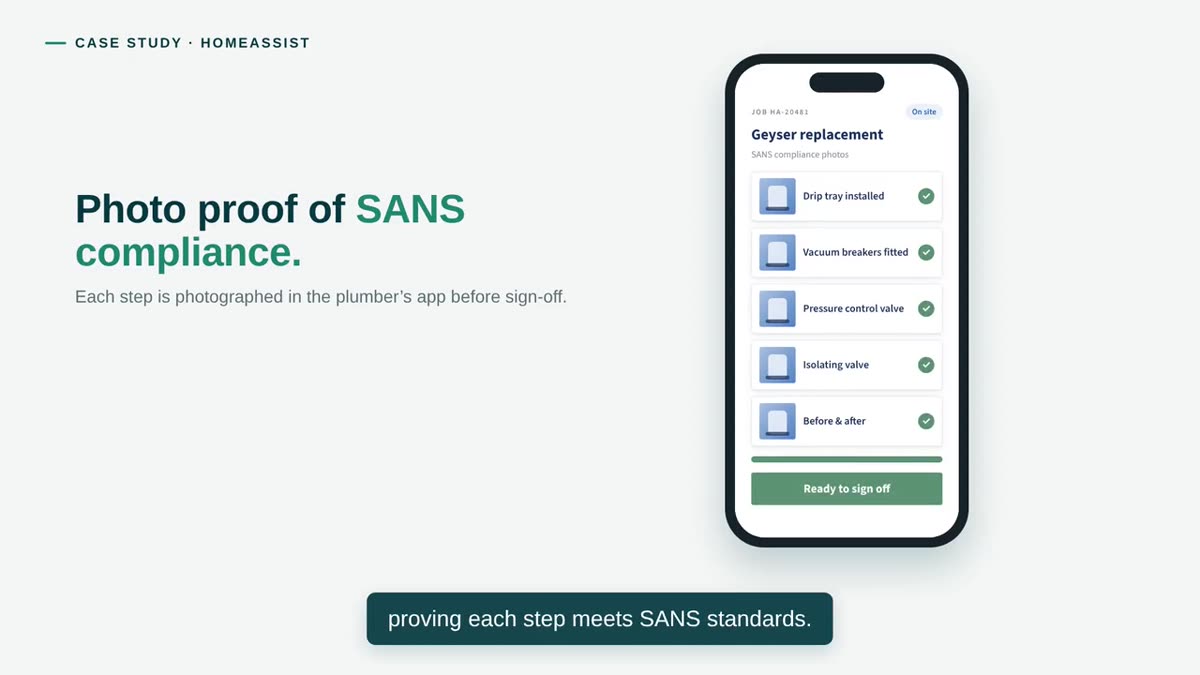
Illustrated in the case study video Photo proof of SANS compliance
On site, the plumber uses the app to photograph the work, proving each step meets SANS standards as it is done.
-
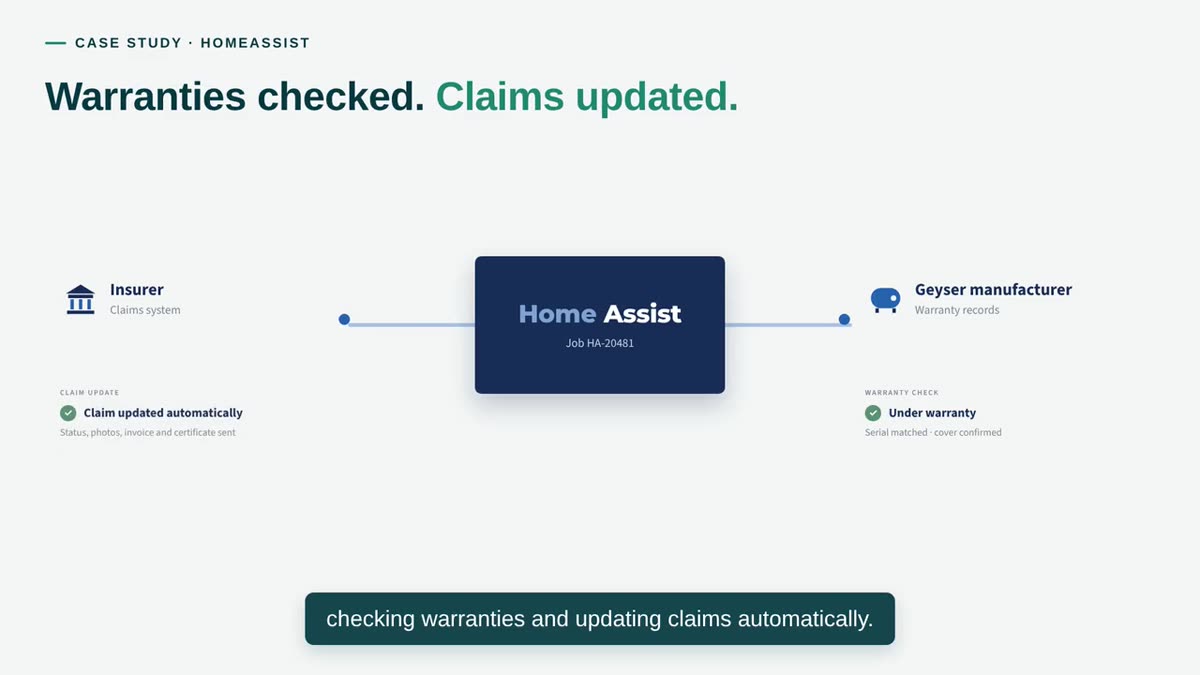
Illustrated in the case study video Warranties checked. Claims updated.
Behind the scenes the system links directly to insurers and manufacturers, checking warranties and updating claims automatically.
-
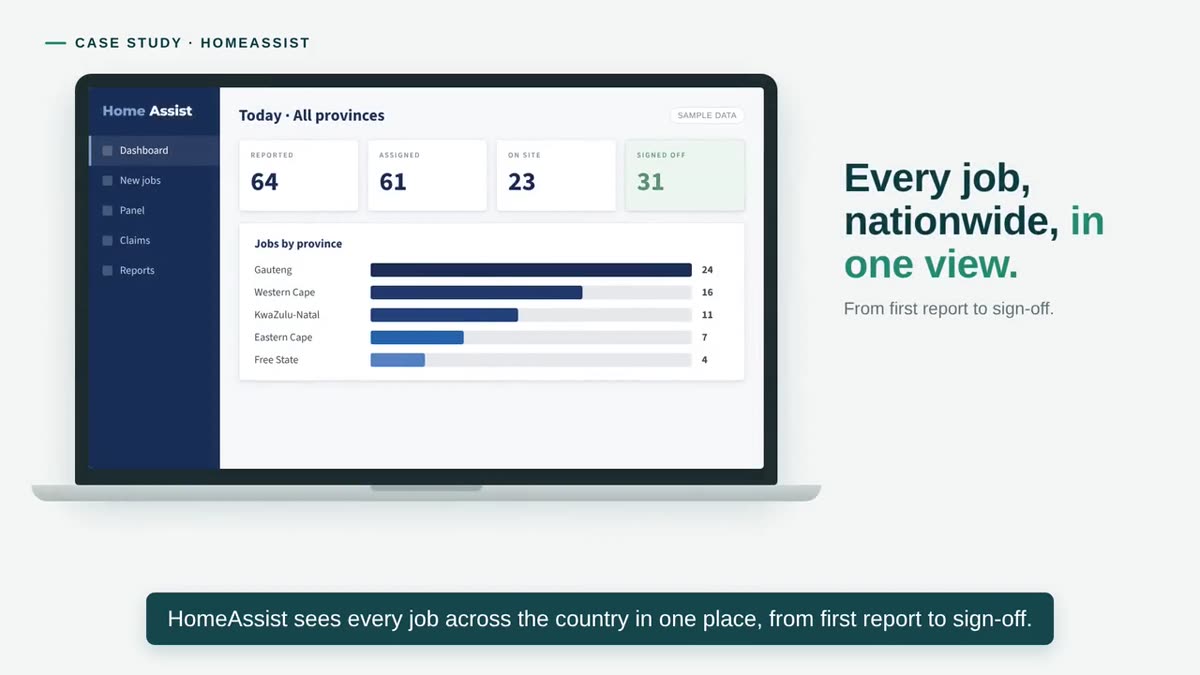
Illustrated in the case study video Every job, nationwide, in one view
HomeAssist sees every job across the country in one place, from first report to sign-off.
Key decisions
Why it was built this way
The decisions the evidence supports: what needed addressing, what GEMIS chose, why, and what was delivered or observed.
-
- Challenge
- Homeowners and insurers reported the same problem through different channels.
- Decision
- One job record with two ways in: the homeowner reports online, or the insurer logs the claim.
- Rationale
- Every party then works from the same job rather than reconciling two versions of it by phone and email.
- Evidence or effect
- Delivered, as shown in the case study.
-
- Challenge
- Assigning a plumber from a national panel meant phoning around.
- Decision
- Assign the next available plumber near the job automatically.
- Rationale
- Dispatch by proximity and availability is faster than any phone round, and it does not wait on a person.
- Evidence or effect
- Delivered, as shown in the case study.
-
- Challenge
- SANS compliance had to be proved after the fact, from paperwork.
- Decision
- The plumber’s app captures a photograph at each step of the repair.
- Rationale
- Evidence captured where the work happens is complete and dated; evidence reconstructed afterwards is neither.
- Evidence or effect
- Delivered, as shown in the case study.
-
- Challenge
- Warranty positions and claim updates meant waiting on manufacturers and insurers.
- Decision
- Link the system directly to insurers and manufacturers.
- Rationale
- The checks that used to be a phone call become part of the job’s own record, and the claim stays current.
- Evidence or effect
- Delivered, as shown in the case study.
Validation, delivery and iteration
What the record shows
Delivery and continued use are the validation the repository can evidence. What it cannot, it says.
On record
- GEMIS and HomeAssist have worked side by side for more than ten years, and the system remains in use (as stated in the case study).
Not documented
- Formal usability testing, user-acceptance records and usage figures are not in the repository, so none are claimed.
Outcomes and business value
Every job across the country visible in one place, from first report to sign-off
Delivered work, verified results and intended benefits are kept apart. Nothing here is a metric the client has not confirmed.
Delivered
- Online reporting, automatic dispatch and customer messaging in one system
- A field app with photographic compliance evidence
- Automated insurer and manufacturer integration and a national dashboard
Verified results
- GEMIS and HomeAssist have worked side by side for more than ten years, and the system remains in use
Intended benefits
- Fewer phone calls for customers, plumbers and the office
- Faster repairs, because dispatch no longer waits on a person
- Compliance and warranty positions evidenced automatically
Built on Microsoft Azure · .NET · SQL · mobile
In their words
The GEMIS team consistently met deadlines and delivered a solution that streamlined our operations, enhancing customer satisfaction and our market position.
Related work
Two projects that share the pattern
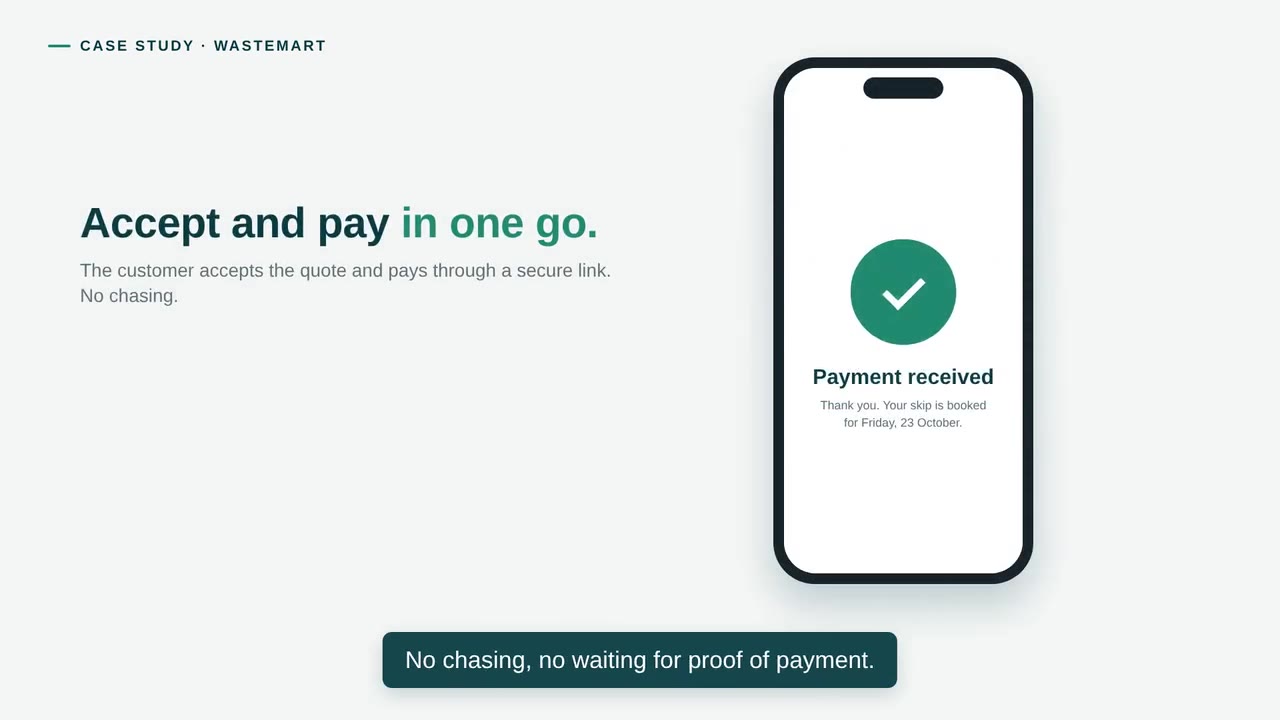
Waste management and skip hire
WasteMart
From quote to collection, handled
- Field operations
- Platforms
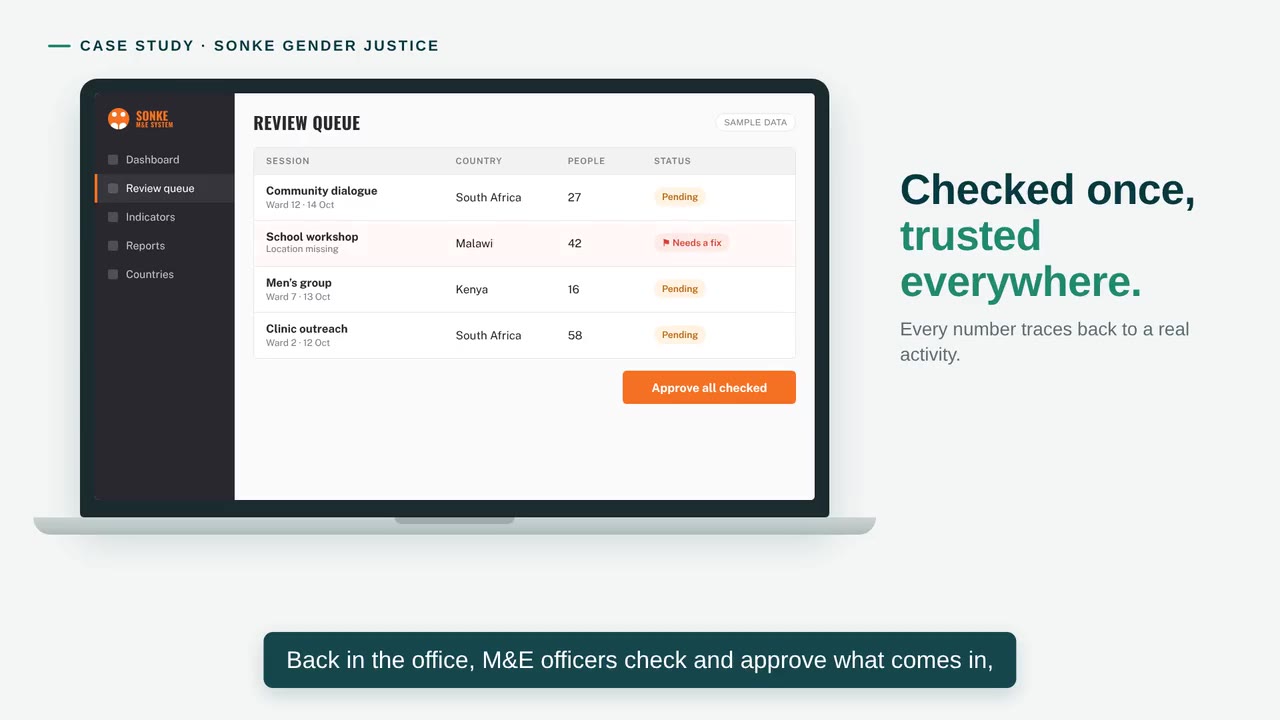
Non-profit — gender-based violence and HIV prevention
Sonke Gender Justice
Monitoring and evaluation across Africa
- Field operations
- Integration
Next steps
Running a field operation across the country by phone? Let’s talk about dispatch, evidence and customer updates in one system.
Tell us what the business needs to do better. We come back within two working days with a short written view and a time to talk — no obligation.